
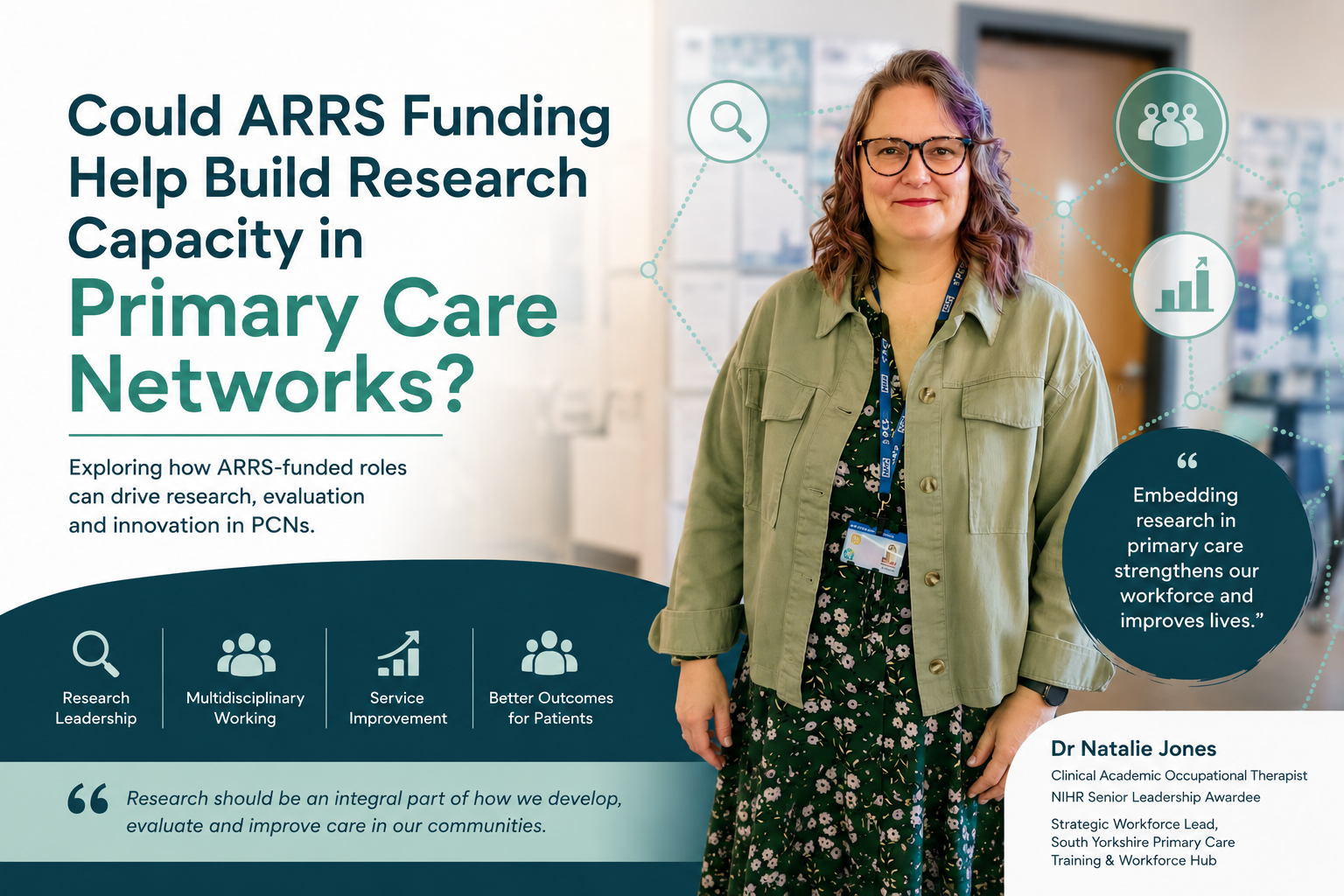
Could ARRS Funding Help Build Research Capacity in Primary Care Networks?
ARRS Roles
The Additional Roles Reimbursement Scheme (ARRS) has transformed the primary care workforce, enabling Primary Care Networks (PCNs) to recruit a wide range of professionals including pharmacists, occupational therapists, physiotherapists, paramedics, social prescribers and advanced practitioners.
The scheme was designed to improve access, support multidisciplinary working and reduce pressure on General Practice. However, as PCNs continue to mature, an important question is emerging:
“How can these roles also contribute to research, evaluation and innovation?”
Research-active organisations achieve better outcomes
There is growing evidence that research-active healthcare organisations achieve better patient outcomes. Research participation can improve staff retention, support workforce development, accelerate the adoption of evidence-based practice and drive service improvement.
Despite these benefits, research activity within primary care remains variable. Many PCNs lack dedicated research infrastructure and often rely on enthusiastic individuals to support research delivery alongside busy clinical workloads.
As healthcare systems increasingly focus on prevention, population health and evidence-based service transformation, there is a growing need to build research capability within primary care itself rather than relying solely on external academic partners.
Can ARRS fund research roles?
Currently, "research nurse" is not an eligible ARRS role. However, several ARRS-funded roles already have responsibilities that align closely with research, evaluation and innovation.
For example, the recently introduced Consultant Nurse in Primary Care role explicitly includes responsibility for leading research, evaluation and implementation of best practice alongside clinical leadership and service development. Similarly, Advanced Practitioners are expected to work across the four pillars of practice: clinical care, leadership, education and research.
This raises an interesting possibility. Rather than creating dedicated research-only posts, could PCNs develop roles that combine clinical delivery with research leadership?
What Are PCNs Already Doing?
While dedicated ARRS-funded research posts remain uncommon, there are several examples of primary care organisations embedding research, evaluation and innovation within existing workforce structures.
Research Leads Within Primary Care Networks
Some PCNs have established formal research leadership roles to coordinate and grow research activity. For example, GP Dr Serge Engamba describes his role as a PCN Research Lead supporting research delivery across practices within a Norwich-based PCN and helping build capability for both NIHR and commercial studies. His experience demonstrates how research leadership can be embedded within existing primary care structures rather than requiring standalone research departments. Read more in the blog 👉https://www.rcgp.org.uk/blog/bringing-research-to-our-practice
Shared Research Infrastructure
In Norwich, practices have worked together to establish a "Norwich Research Hub", creating dedicated research capacity through a networked approach. The hub includes a GP, nurse and coordinator who support research delivery across participating practices. This model demonstrates how PCNs can pool resources to create research infrastructure that individual practices may struggle to sustain independently. GP Dr Serge Engamba talks about the motivations and drivers for research engagement 👉https://youtu.be/Iba12SY2uRE?si=oy_6cCy0zKB7FUWl
Primary Care Research Units
The NIHR Imperial Biomedical Research Centre has developed a Primary Care Research Unit that supports GP organisations across North West London. A key aim of the programme is to help primary care clinicians deliver research alongside their clinical work and develop future research leaders within primary care. https://imperialbrc.nihr.ac.uk/industry/primary-care-research-unit/
Importantly, the programme explicitly supports the development of research capability across multiple professional groups, including medicine, nursing, pharmacy and allied health professions.
Research-Active Primary Care Networks
East Staffordshire Primary Care Network provides perhaps one of the strongest examples of a PCN investing directly in research capacity. The PCN appointed a dedicated Research Manager to coordinate research activity across 18 GP practices serving more than 150,000 patients. https://eaststaffspcn.nhs.uk/proud-winners-of-the-embedding-research-award/
The role was created to establish research systems and infrastructure, support study delivery and embed a research culture across the network. This work subsequently received national recognition through the Clinical Research Network's Embedding Research Award.
Knowledge Mobilisation and Evidence Implementation
Research capacity is not only about delivering studies. Programmes such as the NIHR ARC Greater Manchester Knowledge Mobilisation Champions initiative demonstrate how clinicians can support the translation of research evidence into practice, helping close the gap between research findings and service delivery.
These initiatives show that research leadership, implementation science and evidence mobilisation are increasingly being recognised as core skills within modern healthcare systems.
Could Occupational Therapists Fill This Gap?
Occupational Therapists are already eligible for ARRS funding and are increasingly contributing to proactive care, frailty management, prevention, personalised care and long-term condition management within Primary Care Networks. This creates an interesting opportunity. Rather than establishing dedicated research posts, could PCNs develop Clinical Academic Occupational Therapist or Allied Health Professional Roles that combine patient care, service development, evaluation and research leadership?
Such a role might:
Deliver clinical care within proactive and personalised care pathways.
Lead service evaluation and quality improvement projects.
Support participation in NIHR portfolio studies.
Develop and evaluate innovative models of care.
Build research capability across multidisciplinary teams.
Generate evidence to support business cases and commissioning decisions.
Capture and demonstrate impact using tools such as VICTOR (Visible Impact of Research). https://arc-yh.nihr.ac.uk/research/projects/victor-making-visible-the-impact-of-research/
Strengthen partnerships between primary care, universities and research infrastructure.
Occupational Therapists are uniquely positioned to work across organisational boundaries, considering not only health conditions but also participation, function, independence and quality of life. These perspectives are increasingly important as healthcare systems seek to move from reactive treatment towards proactive and preventative care. Importantly, this approach would align with the original intent of ARRS: bringing new expertise into primary care while improving outcomes for patients and populations. Research would not become a separate activity but an integral part of how services are developed, evaluated and improved.
Looking Forward
The examples highlighted above demonstrate that primary care organisations are already finding innovative ways to build research capacity through Research Leads, Research Managers, Research Hubs and Primary Care Research Units.
The future may not lie in creating dedicated research posts within every PCN. Instead, it may involve developing clinical academic or advance practice roles that combine patient care, service improvement and research leadership.
For Allied Health Professionals and Nurses, this presents an exciting opportunity. As ARRS-funded roles continue to mature, there may be scope to develop a new generation of clinical academic practitioners who not only deliver care but also generate evidence, evaluate impact and support innovation across primary care systems.
“If we are serious about creating research-active primary care systems, we need to move beyond seeing research as an optional extra and start embedding it within the workforce itself”.
Perhaps the question is not whether ARRS can fund research roles, but whether ARRS-funded professionals can help create the research-active primary care systems of the future?
Further Reading
ARRS and GP Contract Resources
NHS England: Network Contract Directed Enhanced Service (DES) https://www.england.nhs.uk/gp/investment/gp-contract/network-contract-directed-enhanced-service-des/
NHS England: Primary Care Workforce Recruited Through ARRS
https://digital.nhs.uk/data-and-information/publications/statistical/mi-primary-care-workforce-recruited-through-the-additional-roles-reimbursement- scheme-arrsNottinghamshire Alliance Training Hub: ARRS Roles in Primary Care
https://www.nottstraininghub.nhs.uk/resources/arrs-roles/PACT is a collaborative research network of enthusiastic primary care team members who want to participate in high impact projects and learn more about research. Established in 2019, PACT now has over 1,000 members across the United Kingdom and is continuing to grow. https://www.gppact.org
Examples of Research in Primary Care
RCGP: Bringing Research to our Practice and Primary Care Network
https://www.rcgp.org.uk/blog/bringing-research-to-our-practiceRCGP Clinical Research Delivery Hub
https://www.rcgp.org.uk/representing-you/research-at-rcgp/research-engagement-hub/clinical-research-deliveryNIHR Imperial BRC Primary Care Research Unit https://imperialbrc.nihr.ac.uk/industry/primary-care-research-unit/
East Staffordshire PCN – Embedding Research Award
https://eaststaffspcn.nhs.uk/proud-winners-of-the-embedding-research-award/Staffordshire and Stoke-on-Trent ICB: Success for East Staffordshire PCN at Clinical Research Network Awards https://staffsstokeics.org.uk/success-for-east-staffordshire-primary-care-network-at-clinical-research-network-awards/
Research Capacity Building
RCGP Research Ready® https://www.rcgp.org.uk/representing-you/research-at-rcgp/research-ready
NIHR Research Delivery Network https://www.nihr.ac.uk/explore-nihr/support/research-delivery-network.htm
West Midlands Research Site Initiative Scheme https://sites.google.com/nihr.ac.uk/wmrrdnpc/practice-staff/research-site-initiative-scheme
About the Author
Dr Natalie Jones is a Clinical Academic Occupational Therapist with over 30 years of experience working across health and social care. Throughout her career, she has held a range of clinical, leadership and service development roles spanning primary, community and secondary care settings. Natalie holds a Master's degree in Clinical Research and a PhD in Stroke Rehabilitation. She is passionate about building research capacity within Nursing and the Allied Health Professions, particularly within primary care, and creating opportunities for clinicians to combine research, leadership and clinical practice.
Natalie was recently awarded an NIHR Senior Leadership Award in recognition of her contribution to clinical academic leadership and workforce development. She is committed to developing innovative approaches that integrate research, practice and service improvement, ensuring that evidence generation and implementation become part of everyday healthcare delivery. Alongside her clinical academic work, Natalie is Strategic Workforce Lead within the South Yorkshire Primary Care Training Hub. In this role, she supports workforce transformation across primary care, with particular expertise in integrated multidisciplinary team working, proactive and personalised care models, workforce redesign, and maximising the potential of the Additional Roles Reimbursement Scheme (ARRS) workforce. Natalie has a particular interest in developing research-active healthcare systems and exploring how clinical academic roles can support service innovation, workforce development and improved outcomes for patients and communities.
