
Love, health, and the spirit of humanity
As an occupational therapist, I’m interested in how people grow, adapt, and remain connected under pressure. This piece explores love as central to health, behaviour, and human flourishing.
After Christmas, curiosity about Henry Drummond’s work stayed with me.
Reading more of Drummond’s work, I was struck not by abstraction, but by how grounded his thinking was in lived life. He was interested in growth and what allows it.
Health as wholeness
Healthcare often defines health by what is absent: symptoms, pain, dysfunction.
Drummond approached health as integration.
A person may be medically stable and yet deeply unwell. Or physically limited and yet profoundly alive. Health emerges from the relationship between body, mind, spirit, environment, and meaning.
Love, in Drummond’s thinking, is central to that ecology.
Love as a vital sign
Drummond’s definition of love is observable. It shows up in how we tolerate frustration, respond to difference, and behave when stressed.
From a behavioural perspective, this is crucial. Chronic irritability, withdrawal, or harshness are often signs of overload or unmet need, not simply character flaws.
Love becomes a kind of vital sign. Its absence has consequences.
Nature and growth
Drummond looked to nature to understand human life. Growth takes time. Nourishment matters. Environment shapes outcome. Love, in this sense, functions like light or water. It is not optional. It is a condition for growth.
“In occupational therapy, we understand health and participation through the lens of fit, between person, environment, and occupation, as described in the PEOP model. Drummond’s thinking reflects this same systems view: that people do not thrive or struggle in isolation, but in relationship to the environments and demands that surround them.”
The PEOP model understands human participation as emerging from the relationship between:
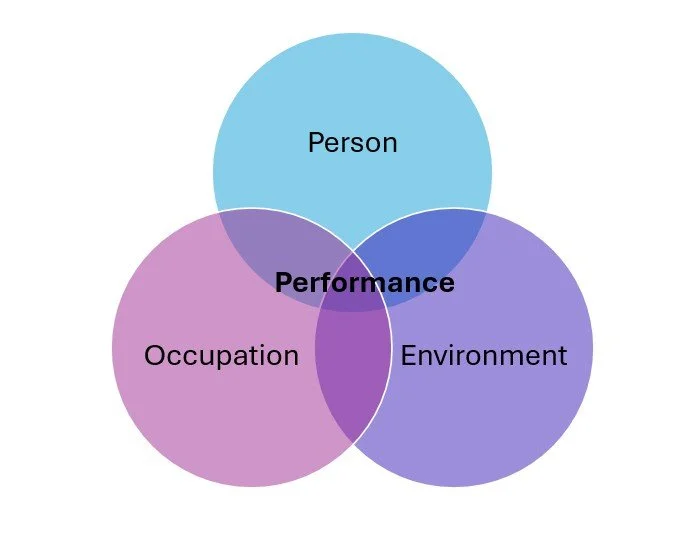
https://journals.sagepub.com/doi/pdf/10.1177/15394492241252578 Over View of the PEOP Model
Person — cognitive, emotional, physical, sensory, spiritual capacities, alongside identity and roles
Environment — physical, social, cultural, institutional, and socioeconomic contexts
Occupation — the activities and roles through which people care for themselves, express meaning, and find fulfilment
Performance — the lived expression of doing, shaped by the interaction of person, environment, and occupation
Small acts, sustained health
Life, Drummond wrote, is shaped not by grand gestures, but by small, repeated actions.
From a therapeutic perspective, this is familiar. Habits matter. What is done consistently shapes who we become.
Love practised daily becomes health-promoting behaviour.
A Bridge Forward
This raises a deeper question, one that moves beyond theory:
What happens when love is most needed, and least fixable? I will explore these concepts further in blog 3.
Author’s Note
I write these reflections as an occupational therapist and health professional, with a long-standing interest in human behaviour, adaptation, and meaning, particularly in moments of vulnerability, transition, and loss. This is not a clinical or theological series, but a reflective one, written at the intersection of professional understanding and lived experience.
