
Research & Evaluation
Reflections and insights from practice, research, and leadership — exploring how healthcare teams can learn, collaborate, and innovate for the future.



Selected Publications
Research & Service Improvement
Organisational benefits of undertaking healthcare research: an approach to uncover impact. BMC Research Notes, 16(1), 255. https://doi.org/10.1186/s13104-023-06526
Making occupational therapy research visible: amplifying and elevating the contribution and impacts. British Journal of Occupational Therapy, 84(4), 197–199. https://doi.org/10.1177/0308022620988473
Weaving a clinical academic career. British Journal of Occupational Therapy, 82(1), 60–64. https://doi.org/10.1177/0308022618784258
User attitudes towards virtual home assessment technologies. Journal of Medical Engineering & Technology. https://doi.org/10.1080/03091902.2022.2089250
Remote home visits: Exploring the concept and applications within health and social care. British Journal of Occupational Therapy. https://doi.org/10.1177/03080226211000265
Occupational therapists need to be involved in developing and evaluating technological solutions to support remote working. British Journal of Occupational Therapy, 84(2), 69–71. https://doi.org/10.1177/0308022620979517
Remote Home Visit: Exploring feasibility and benefits of using digital tech in OT home assessments. British Journal of Occupational Therapy, 83(10), 648–658. https://doi.org/10.1177/0308022620921111
BISTRo- Breakfast Group Interventions in Stroke Rehabilitation
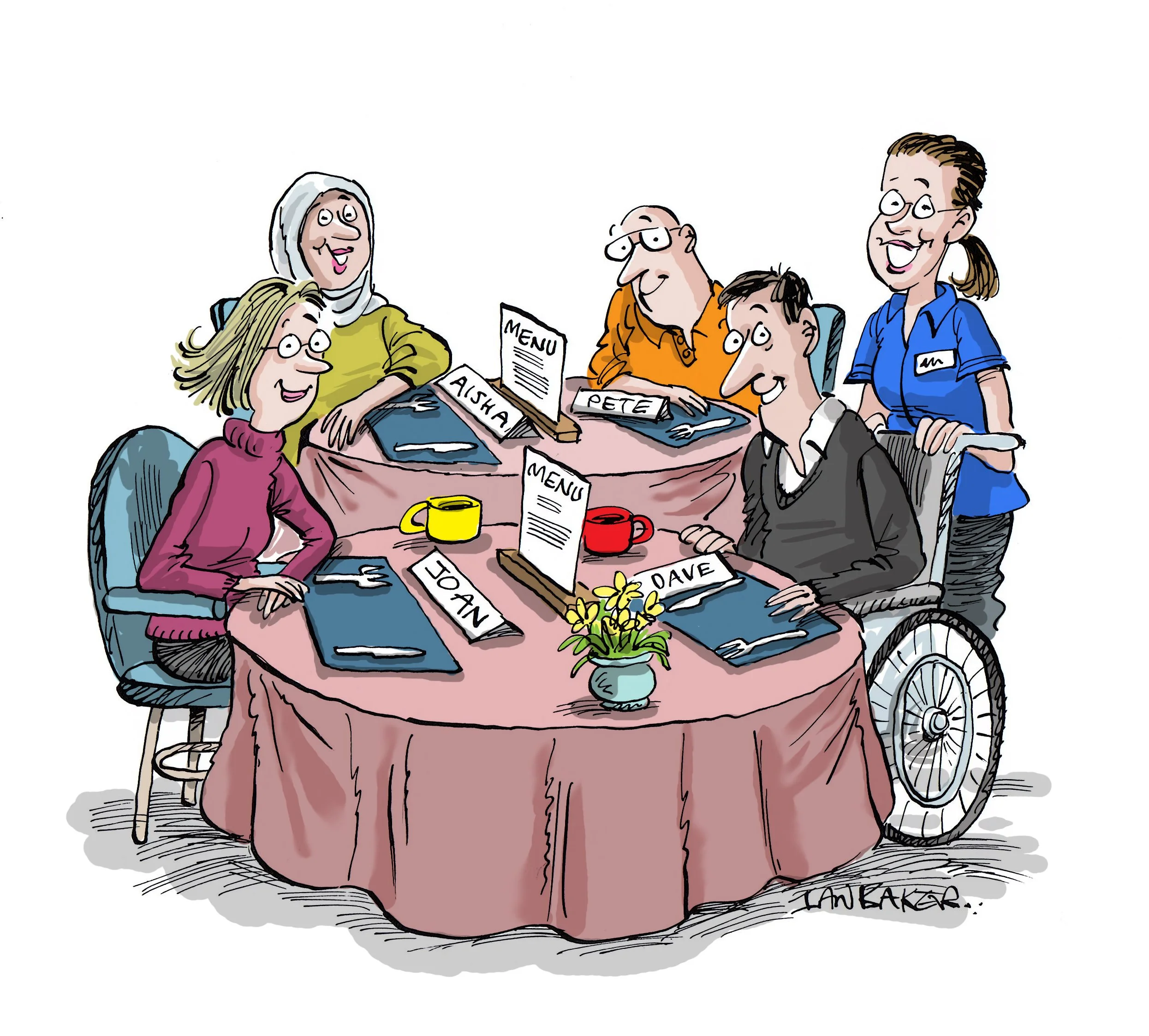
BISTRo is a co-designed breakfast group that supports stroke survivors to practise eating and drinking skills, build confidence and connect with others during rehabilitation.
We conducted a mixed-methods feasibility study across three wards in three NHS hospitals, involving sixteen stroke survivors and fifty-three multidisciplinary staff. We examined attendance and outcome measures alongside patient interviews and staff focus groups. Our focus was whether the intervention and research procedures were workable, and what needed refining before a larger evaluation.
Patients valued the shared experience. One described breakfast group as ‘the best hour of my day’. Another said it made them feel like a person again.
Staff described shared ownership across disciplines. One explained: ‘It only worked because everyone felt it was our group, not just Occupational Therapists.’
What comes next?
This small study across three hospital sites established that BISTRo was feasible and acceptable within acute stroke rehabilitation. High attendance, consistent delivery and positive patient and staff experiences provide a strong foundation for further evaluation of its clinical and cost-effectiveness.
BISTRo offers a way to make an everyday meal a meaningful opportunity for rehabilitation.
-
The psychosocial impacts of having eating and drinking difficulties after stroke: a qualitative evidence synthesis
Jones, N. et al. (2026). Disability and Rehabilitation.
Read the paper The evidence review underpinning BISTRo’s focus on psychological and social recovery.The experiences of stroke survivors with eating and drinking difficulties, in acute stroke units: a qualitative inquiry
Jones, N., Mawson, S., Drummond, A., Booth, L. and O’Cathain, A. Published online in 2025; appears in the 2026 volume of Disability and Rehabilitation, 48(10), 2975–2988.
Read the paper tandfonline.comDeveloping a rehabilitation intervention for eating and drinking difficulties following stroke through co-design stakeholder workshops
Jones, N. et al. (2026). BMC Health Services Research, 26, article 1248.
Read the paper
Describes the co-design process, intervention components and implementation toolkit. Springer Nature LinkFeasibility and acceptability of the breakfast group intervention BISTRo for stroke survivors in acute rehabilitation
Jones, N., Mawson, S., Drummond, A. and O’Cathain, A. (2026). Clinical Rehabilitation.
Read the paper The multisite feasibility study featured in your current poster.Doctoral thesis brings the programme together.
The development, feasibility, and acceptability of a breakfast group intervention for stroke rehabilitation — Natalie Jones, University of Sheffield. The repository lists it as 2024.
Access the thesis and download the full text. White Rose eTheses Online
An earlier related publication:
6. The experiences of stroke survivors with managing eating 6 months post stroke — Jones, N. and Nasr, N. (2018). British Journal of Occupational Therapy, 81(2), 106–115.
Read the paper. Natalie Jones, Nasrin Nasr, 2018 -
Introducing the BISTRO Study
https://youtu.be/b4vGBdhDpLA?si=-TLZG_Hc1gjZDXOe
BISTRo Study Tigger Video 1: Exploring the importance of eating and drinking after stroke. https://youtu.be/xhdwlYLu1VU (6.52mins)
BISTRO Study Trigger Video 2: The impact of eating and drinking difficulties after stroke. https://youtu.be/s9gPNyNJDjM (11.10mins)
BISTRo Study Trigger Video 3: What to consider if you are planning a breakfast group intervention. https://youtu.be/UQZ_3NRXBCo (28.26mins)
An Occupational Therapist talking about ‘what matters to you’. https://youtu.be/mFHxb6dkqUQ (7.41mins)
BISTRo Study: The story of developing a breakfast group intervention for stroke survivors. https://youtu.be/xTvDX6bs4vQ (10.36 mins)
BISTRo Study: Experiences-based codesign with stroke survivors & informal carers in stroke research. https://youtu.be/mFHxb6dkqUQ (16.37mins)
Systematic Review: Psychosocial impacts of eating and drinking difficulties after stroke. https://youtu.be/yCUxd_4hU28 (4.32mins)
-
The BISTRo toolkit
BISTRo is a co-designed breakfast group that supports stroke survivors to practise eating and drinking skills, build confidence and connect with others during rehabilitation.
The BISTRo toolkit brings together resources to help multidisciplinary teams plan, deliver and review breakfast groups in stroke rehabilitation settings.
What’s included?
Staff training resources — an intervention training protocol and training packs introducing BISTRo and supporting staff preparation.
Assessment and guidance — resources to identify eating and drinking rehabilitation needs and inform individual goals and treatment plans.
Patient-held BISTRo booklet — a personal record of food and drink preferences, goals, strategies, session activities and progress.
Outcome measures — resources to explore changes in eating and drinking self-confidence, social confidence and positive attitude.
Menus and communication aids — menus, place-name cards and food and drink labels to support choice and participation.
Conversation resources — guidance for supporting people with aphasia and prompts to encourage conversation and peer interaction.
Environment and equipment checklists — resources to help teams prepare the dining space and identify the equipment needed.
Ward coordination materials — visual prompts, patient-record alerts and signs to support preparation for groups and communication between staff.
Risk assessment and operating procedures — templates to support local planning, risk review and consistent delivery.
Find out more
To learn more about the BISTRo toolkit, its resources and how it could support your service, please contact Dr Natalie Jones at drnataliejonesconsulting@gmail.com.Item description

“You always made things happen — calm, organised, and uplifting.”
Ready to start a conversation?